
Academic programme
EYFS (KS1)
We follow the Cambridge Early Years curriculum, which is designed to nurture young learners through a child-centered, play-based approach. Key features include:
- A holistic learning model that supports the overall well-being and development of the child, both as an individual and as part of a wider community.
- Emphasis on learning through play, encouraging curiosity, imagination, and active exploration.
- Four key areas of development form the foundation of the curriculum:
- Physical development – building strength, coordination, and movement.
- Language and communication – developing speaking, listening, and early literacy skills.
- Cognitive development – encouraging problem-solving, thinking skills, and early understanding of concepts.
- Social and emotional development – fostering confidence, cooperation, and emotional awareness.
This approach ensures that each child builds a strong foundation for future learning in a joyful and supportive environment.
Primary (KS2)
The Cambridge Primary Programme (KS2) sets young learners on an exciting educational journey, nurturing them into confident, responsible, reflective, innovative, and engaged individuals. Designed for students aged 5 to 11 years, this internationally recognized curriculum provides a broad and balanced education, equipping children with the skills and knowledge they need to succeed in school, work, and life.
With 12 subjects, including core areas like English, Mathematics, and Science, our primary programme builds strong academic foundations while fostering creativity, self- expression, and personal well-being. Thanks to our dedicated teachers, we create
engaging and dynamic learning experiences, ensuring that every child develops a love for learning and the ability to thrive in their future education and beyond.
The 12 subjects are: Art, Drama, Physical education, Music, Computing, Mathematics, English as a second language, English as a first language, Science, Global perspectives, French and Arabic
Primary Checkpoint:
- Taken at the end of primary schooling.
- Covers English, English as a Second Language, Mathematics, Science, and
Global Perspectives.
- Fully marked externally (except Global Perspectives, which is teacher-marked and moderated).
- Provides a Statement of Achievement and detailed feedback on strengths and weaknesses to guide next steps.
- Enables schools to benchmark performance against global standards
Secondary
Secondary is divided into 3 stages:
Key Stage 3 (Year 7, Year8 & Year 9 – Lower Secondary)
The same 12 subjects taught in primary school are taught in lower secondary.
At the end of key stage three students sit for lower secondary checkpoint. In checkpoint students choose to sit four, three, two or one of the following subjects: global perspectives, Math, science and English first or second language.
Key Stage 4 (Year 10 & Year 11 - IGCSE)
The IGCSE is a two-year international qualification taken in Years 10 and 11. Most of the content- approximately 70 %– is covered during Year 10 before students narrow their focus in Year 11 to complete the remaining curriculum and sit final exams.
Year 10 curriculum choice for 2025-2026
The Pedagogical Committee has decided-after reviewing the class results, to give the new Year 10 students the opportunity to study all subjects in their first year of IGCSE (Year 10). This will allow them to explore their interests before specializing. A mid-year review will be conducted to evaluate students’ progress and subject preferences, which will guide the creation of subject blocs for Year 11.
Year 10: Foundation Curriculum
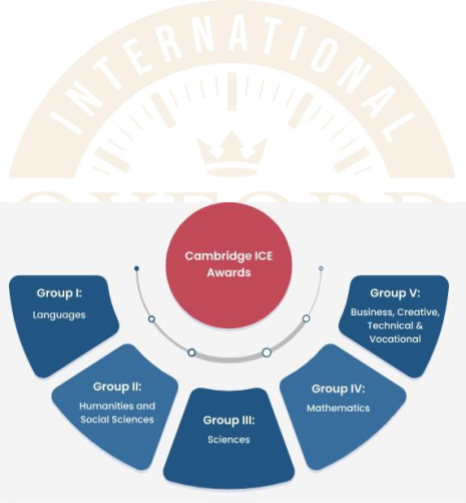
In Year 10, all students follow a broad programme designed to reflect the subject-group structure of Cambridge International:
- English (Second Language)
- Mathematics
- Sciences: Biology, Chemistry, Physics
- Global Perspectives
- Business Studies
- Computer Science
- French or Arabic
This immersive schedule builds around 60-70 % of the IGCSE syllabus content and ensures students are well-prepared for differentiated learning in Year 11.
Please Note:
- At the end of Year 10, students choose one of two academic tracks, either Medicine or Engineer, to follow in Year 11. Each track guides the subjects they cover and prepares them for their IGCSE examinations in Year 11.
- At the end of Year 10, students will sit for their French or Arabic language examination, depending on which language they have studied during the year. keeping in mind not to exceed the 13-month carry forward period.
Year 11 tracks for this year 2025-2026
For this academic year, Year 11 students will continue with the subject tracks they selected in Year 10, as illustrated below.
Science Track | Combined Science / Business Track |
Biology | Computer Science |
Chemistry | Business Studies |
Physics | Combined Science |
Mathematics | Mathematics |
English | English |
Global Perspectives | Global Perspectives |
Please Note: “Combined Science” is one-award course, covering Biology, Chemistry, and Physics in less depth than taking all three as separate subjects.
Year 11: Final Preparation & IGCSE Examinations
In Year 11, students build on the remaining ~30 % of the curriculum of their chosen subjects. At the end of Year 11, they sit their final Cambridge IGCSE exams, which generally include:
- Multiple papers per subject (e.g., Paper 1, Paper 2)
- Alternative to practical components (in sciences)
- Coursework or oral assessments where applicable
Note: As part of our academic vision for the upcoming year, we are considering phasing out Combined Science. This decision will be based on a thorough evaluation of the subject’s effectiveness, students’ levels and interests, as well as staff availability. Any changes will only be made if they are pedagogically sound and logistically applicable, with the aim of offering a more tailored and engaging science curriculum.
Any updates for next year will be communicated through orientations days which will be communicated to parents and students as needed
Key Stage 5 (Years 12 & 13 – A Levels)
At the beginning of Year 12, students select one subject block and study three A-Level subjects over the course of two years.
The A-Level program consists of two parts:
- AS Level in Year 12
- A2 Level in Year 13
At the end of each year, students sit for different sets of examination papers for each subject. Together, these exams determine the full A-Level qualification.
Subject Blocks Offered
Students must choose one of the following blocks, which are designed to support various career and university pathways.
Block Name | Subjects Offered |
Medicine Block | Mathematics – Biology – Chemistry |
Engineering Block | Mathematics – Physics – Computer Science |
Business Block | Mathematics – Business Studies – Physics |
Private Candidacy Option
If a student wishes to take an A-Level subject not offered by the school, they may register for that subject as a private candidate. In such cases, the student is responsible for preparing independently or with external support and will still sit the official Cambridge exams at OIST.
Progression Policy
To encourage excellence and ensure readiness for higher-level studies, our school applies the following rules:
- From Secondary to A Levels: Students must achieve a passing grade in their IGCSE subjects. Those who do not pass will not be permitted to move on to A Levels.
- From AS to A2: Students must achieve a passing grade in their AS subjects. Those who do not pass will not be permitted to continue to A2.
This policy is in place to support students’ success and to make sure they are fully prepared for the academic challenges ahead.